|


|
Fort Myers gateway to islands, wildlife
Fort Myers, a thriving city rich in history and nature, serves as gateway to a stretch
of islands known for their white-sand beaches, bird life and recreational opportunities.
The city hugs the shores of the wide Caloosahatchee River, which created the town
and levered its importance during the Seminole Wars. Since the early 1800s, settlers
and visitors of fame and wealth came to Fort Myers and area, most notably light
bulb inventor Thomas A. Edison, who built his home, laboratory and botanical gardens
between the river and McGregor Boulevard, the town’s most celebrated drive, thanks
to Edison. He lined the old road with stately royal palms that remain a signature
today. His contributions to the city (he also plugged Fort Myers into electricity)
are celebrated on his birthday every February with the Edison Festival of Light
Pageant, culminating in a nighttime parade.
Professional theater, a sophisticated performing arts hall and two sports parks,
which host the Boston Red Sox and Minnesota Twins for spring training, provide entertainment
in the Fort Myers area. Downtown is evolving into a lively night scene where clubs,
coffee houses, street performers and cafes draw a young, artsy crowd. For nature
lovers, parks preserve fragile habitat while providing trails for hiking, biking
and paddling. Manatee Park is home to a herd of endangered Florida manatees that
come to winter in its warm waters every year. Visitors can kayak among them or listen
to their singing through special hydrophones. Cape Coral, popular for its family entertainment attractions, and North Fort Myers, home to the vintage Shell Factory & Nature Park, face Fort Myers on the Caloosahatchee River’s northern banks. Pine Island, a long island that holds tenaciously to its deep fishing and farming heritage, hides in the Intracoastal Waters off Cape Coral. Ancient Calusa Indian mounds and a funky small-town artist village bring culture-seekers to this island that celebrates its signature crop each July at the MangoMania festival.
Besides canoeing and kayaking, the islands lure with nature boat tours, fishing and shelling charters, a sailing school, boat rentals, parasailing, sightseeing voyages, and cruises to the upper islands, reclusive and accessible only by boat. Shelling, secluded beaching, nature hikes, camping, lunching and cottage or home rentals beckon adventurers to these castaway islands and have since the days of Zane Grey, Mary Roberts Rinehart, and Hedy Lamar. Teddy Roosevelt based his circa-1914 fishing excursion on Captiva Island, a favorite haunt also of aviator Charles Lindbergh and his wife Anne Morrow Lindbergh, who penned her Gifts From the Sea there. |


 Edison
eventually persuaded his friend Henry Ford, of automobile fame, to build next door
and both homes are open today to inform visitors of local history, along with other
historic museums and sites. One of the area’s most unusual historic attractions,
Koreshan State Historic Site, memorializes a turn-of-the-20th-century utopian cult
that brought culture to the wilderness. It is located in
Estero in the vicinity of Florida’s youngest state university, Florida
Gulf Coast University.
Edison
eventually persuaded his friend Henry Ford, of automobile fame, to build next door
and both homes are open today to inform visitors of local history, along with other
historic museums and sites. One of the area’s most unusual historic attractions,
Koreshan State Historic Site, memorializes a turn-of-the-20th-century utopian cult
that brought culture to the wilderness. It is located in
Estero in the vicinity of Florida’s youngest state university, Florida
Gulf Coast University.
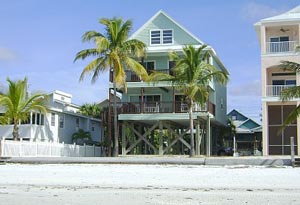 Main among Fort Myers’ litany of barrier islands are Fort Myers Beach, a bustling beach town
priced for families; Sanibel Island, centered
around its famous shelling beaches and birding mecca at J. N. "Ding" Darling
National Wildlife Refuge; Captiva Island,
a jumble of quirky shops and restaurants; and Bonita
Beach, where the Great Calusa Blueway paddling trail begins to head
north 90 miles. Sanibel is also home to the one-of-a-kind Bailey-Matthews Shell
Museum, plus a historic village and a couple of nature attractions. Its Tarpon Bay
lies along the Blueway and is part of the wildlife refuge. Roseate spoonbills, bald
eagles, ospreys, manatees, dolphin, sting rays, tarpon and bob cats dwell in forests
and waters of the refuge.
Main among Fort Myers’ litany of barrier islands are Fort Myers Beach, a bustling beach town
priced for families; Sanibel Island, centered
around its famous shelling beaches and birding mecca at J. N. "Ding" Darling
National Wildlife Refuge; Captiva Island,
a jumble of quirky shops and restaurants; and Bonita
Beach, where the Great Calusa Blueway paddling trail begins to head
north 90 miles. Sanibel is also home to the one-of-a-kind Bailey-Matthews Shell
Museum, plus a historic village and a couple of nature attractions. Its Tarpon Bay
lies along the Blueway and is part of the wildlife refuge. Roseate spoonbills, bald
eagles, ospreys, manatees, dolphin, sting rays, tarpon and bob cats dwell in forests
and waters of the refuge.
|